How Angola Turned a Fashion Designer into a “Terrorist”

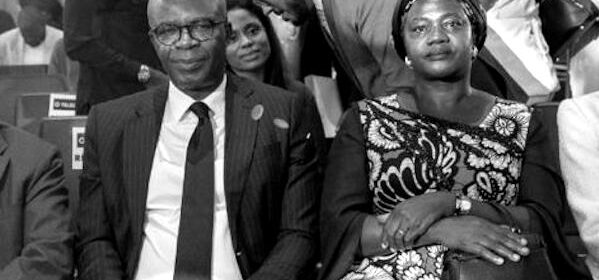
Arrested at dawn, stripped of her dignity, and accused of ISIS links without a single act of violence or any evidence, Aisha Lopes became the symbol of a state willing to criminalise faith and invent enemies to justify repression. This report summarizes the case of Aisha Lopes and co‑accused, originally published by Maka Angola in 2017. It demonstrates how the Angolan state fabricated terrorism allegations against innocent citizens — using intimidation, torture, and legal manipulation — in ways that mirror the recent cases of “terrorism” and “espionage” against journalists, youth leaders and association members. The Aisha Lopes case is included here so observers can understand the continuity of abusive investigative methods, the criminalization of religious minorities, and the systematic invention of internal enemies for political purposes. Background of the case On 2 December 2016, just before dawn, more than twenty agents from the Criminal Investigation Service (SIC) and associated security […]

Read more

Amor Carlos Tomé: From Journalist to “Terrorist” (Part I)

A public broadcaster journalist is charged with terrorism for texts describing a taxi strike that urged citizens to stay home. The case raises urgent questions about press freedom and criminal law in Angola. The Public Prosecutor’s Office accuses two Russian citizens and two Angolans of jointly committing the crimes of espionage, terrorism, terrorist organization, influence peddling, and criminal association. In this second article of the series, we examine in detail the case of Amor Carlos Tomé, a sports journalist at Angola’s public broadcaster Televisão Pública de Angola (TPA), portrayed in the indictment as the principal executor of an alleged Russian operation of terrorism and espionage aimed at staging a coup d’état against President João Lourenço. On 8 January, the Luanda District Court, 3rd Criminal Section, will begin hearing the defendants in the adversarial pre-trial phase. The accused are the Russian nationals Lev Lakshtanov (65) and Igor Ratchin (38), Francisco Oliveira […]

Read more

Angola: When the Party Enters the Bank

Angola’s continued placement under enhanced monitoring by the Financial Action Task Force(FATF) has once again exposed deep structural weaknesses in the country’s banking system. More than the existence of laws, what is at stake is Angola’s ability to demonstrate, in practice, an effective separation between political power, bank ownership, and financial supervision. The high concentration of politically exposed persons (PEPs) within the financial system — often concealed through opaque corporate structures — continues to undermine institutional credibility in the eyes of international regulators and partners. When the FATF placed Angola under enhanced monitoring in October 2024, the decision was framed as a technical alert. It led to clear political-institutional and economic consequences: heightened international scrutiny, increased compliance costs for correspondent banking relationships, and a higher perception of country risk. The overlap between political power and the banking system is not new in Angola. Over the years, several financial institutions have […]

Read more

Angola: The Country of Lourenço

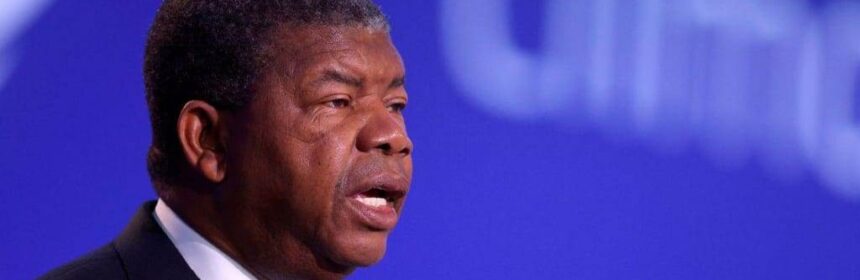
Over the past years, Angola has come to be governed less as a republic and more as a personalized system of power. What once functioned as a party-state has gradually evolved into something narrower and more concentrated: a president-state. This transformation did not occur through rupture or overt authoritarian declaration. It unfolded quietly, through administrative practice, selective enforcement of the law, and the steady erosion of institutional counterweights. João Lourenço did not invent this system — but he consolidated and personalized it. For decades, Angola operated under a party-state logic, in which the ruling party absorbed state institutions. Under Lourenço, that model shifted. The party was not democratized; it was subordinated. Decision-making migrated from collective party bodies to the presidency itself. Today, the ruling party functions less as a space for deliberation and more as a mechanism of validation. Internal competition is discouraged, dissent is neutralized, and succession is carefully […]

Read more

Peace in DRC Won’t Come From a Signature

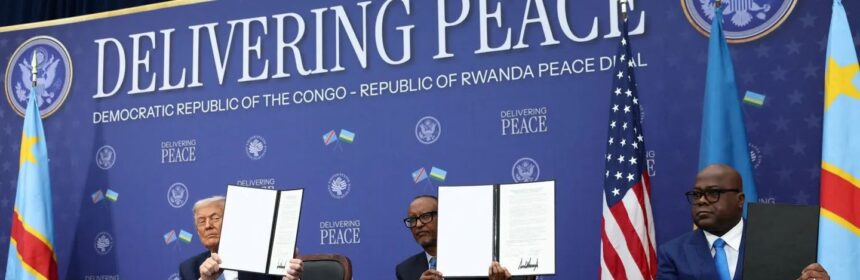
The Washington Agreement, presented with great ceremony as a turning point for peace in eastern Congo, unravelled almost instantly. Within hours of the signatures drying, fighting resumed across the region. The M23/AFC rebels—backed by Rwanda and not party to the agreement—accused government forces of launching new offensives. Kinshasa, in turn, reported fresh Rwandan bombardments of Congolese positions. The fanfare in Washington did nothing to alter facts on the ground. What the event did achieve was political theatre. The deal served primarily to bolster Donald Trump’s image as a peacemaker, echoing—deliberately or not—the misguided confidence of Neville Chamberlain in 1938, when he sought to secure peace by conceding Czechoslovakia to Nazi Germany. Like Chamberlain, Trump appears to believe that conflict can be contained with well-timed handshakes and generous rhetoric. Reality has already contradicted him. Yet buried within the diplomatic spectacle lies one idea with real potential: the Regional Economic Integration Framework […]

Read more

Debunking the Myths of the Lobito Corridor

If hypocrisy needed a railway, it would look exactly like the Lobito Corridor. It is being hailed as a symbol of African progress. In truth, it is a mirror of everything negative the continent endures: Chinese debt, Western opportunism, Congolese blood, Angolan misrule—and a railway that connects foreign interests more efficiently than it connects the people who live along its tracks. It promises prosperity while delivering the same old extraction dressed in new flags. As Angola hosts the 7th African Union–European Union Summit, one of the flagship projects presented as proof of renewed partnership is the Lobito Corridor. Over the past year, Washington, Brussels and several media outlets have portrayed the corridor as a strategic Western response to China’s expanding influence in Africa—a seductive narrative suggesting a geopolitical comeback. President João Lourenço echoes this view, selling it as his diplomatic triumph and economic breakthrough. Yet the narrative collapses under basic […]

Read more

The Regime That Needs Enemies to Rule

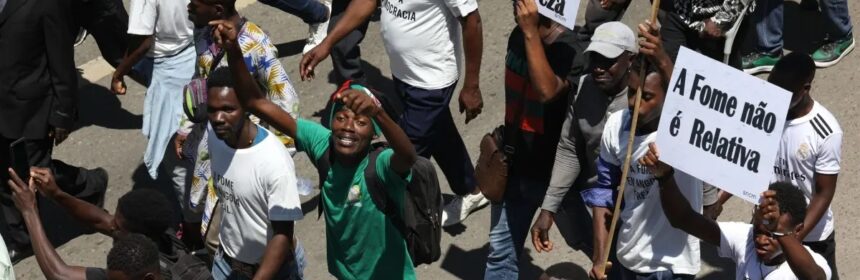
On July 28 and 29 the taxi drivers’ strike caused serious unrest and political tremors in Angola. The authorities violently suppressed the protests, resulting in more than 30 deaths and over 1,200 detentions. As usual, the government needed to construct a narrative of foreign interference to explain popular discontent and the crackdown. In a coordinated operation by defense and security bodies, the Angolan state accused Russia of fomenting acts of terrorism in Angola and detained two Russian citizens as “proof.” Three months later, the suspects still do not know what prosecutorial measures have been taken against them. Since 1975 Angola has maintained military cooperation with Moscow. On this historical basis, the commander‑in‑chief of the Angolan Armed Forces (FAA), President João Lourenço, has a top adviser — Lieutenant General I. Krasin of the Russian Armed Forces — with an office in the Military House of the Presidency at the Cidade Alta Palace. That same general also advises the […]

Read more

Nova Cimangola: Angola’s Independence for Sale

In his State of the Nation Address, President João Lourenço proudly declared that Angolans are celebrating “50 years as a sovereign State, 50 years as a free people, masters of their own destiny.” Yet for many Angolans, these words ring hollow. Nova Cimangola — seized by the Angolan State in 2020 after reclaiming the 49% stake formerly held by Isabel dos Santos — should have been a symbol of restored economic sovereignty. Instead, it has become a textbook case of internal neo-colonialism, where Angolan citizens watch their own public enterprise treat them as second-class workers on their own soil. A New Colonial Caste System More than 1,000 Angolan employees receive low wages at Nova Cimangola. Meanwhile, just 70 expatriates are paid over US $13 million annually — more than the total payroll of the entire local workforce. A Portuguese cafeteria manager earns US $8,000 a month — far more than […]

Read more

President Lourenço: Where Does Angola Go from Here? 

The foundation of Angola’s future prosperity rests upon four pillars. Firstly, empowering and visionary leadership at the executive level, capable of bridging the numerous divides in Angola’s society to unite the country’s citizenry and institutions to work towards common prosperity. Secondly, the presence of strong legal institutions capable of upholding the rule of law. Thirdly, the economic emancipation and continued preservation of the populace’s economic freedom. Lastly, a well-crafted and well-defined blueprint to ensure access to freedom and justice for all.   The foundation of any prosperous nation-state is the presence of robust and fair leadership in its government combined with strong and well-functioning institutions. The aforementioned qualities give rise to a nation that is governed democratically and equitably, with branches of government working in symphony to uphold the rule of law and achieve common prosperity. In such a nation, all branches of government work together to foster a legal climate capable […]

Read more

Justice Capture in Angola

President Lourenço has weaponized the judicial system to mete out political retribution against his personal enemies, principally his predecessor’s family members and closest associates. The unequal application of justice gives every appearance of protection for some of the most notoriously corrupt public officials, in exchange for their allegiance. A few days ago, Angola’s Criminal Investigation Service arrested a young man, Flávio Caiongo, over a TikTok video. His crime? Calling our President Lourenço a “thief”. His TikTok was critical of the poor rule that plagues Angola, and has left so many of my fellow Angolans hungry. As I stand here, the authorities are still hunting down the other two people who took part in it. It’s ironic. Twenty-three years ago, Angola’s then President, José Eduardo dos Santos, put me in jail for calling his régime “corrupt”. When President Lourenço succeeded him in 2017, he promised change: an end to kleptocracy, respect […]

Read more
1 2 3 4 18