Angola: When the Party Enters the Bank

Angola’s continued placement under enhanced monitoring by the Financial Action Task Force(FATF) has once again exposed deep structural weaknesses in the country’s banking system. More than the existence of laws, what is at stake is Angola’s ability to demonstrate, in practice, an effective separation between political power, bank ownership, and financial supervision. The high concentration of politically exposed persons (PEPs) within the financial system — often concealed through opaque corporate structures — continues to undermine institutional credibility in the eyes of international regulators and partners. When the FATF placed Angola under enhanced monitoring in October 2024, the decision was framed as a technical alert. It led to clear political-institutional and economic consequences: heightened international scrutiny, increased compliance costs for correspondent banking relationships, and a higher perception of country risk. The overlap between political power and the banking system is not new in Angola. Over the years, several financial institutions have […]

Read more

Angola: The Country of Lourenço

Over the past years, Angola has come to be governed less as a republic and more as a personalized system of power. What once functioned as a party-state has gradually evolved into something narrower and more concentrated: a president-state. This transformation did not occur through rupture or overt authoritarian declaration. It unfolded quietly, through administrative practice, selective enforcement of the law, and the steady erosion of institutional counterweights. João Lourenço did not invent this system — but he consolidated and personalized it. For decades, Angola operated under a party-state logic, in which the ruling party absorbed state institutions. Under Lourenço, that model shifted. The party was not democratized; it was subordinated. Decision-making migrated from collective party bodies to the presidency itself. Today, the ruling party functions less as a space for deliberation and more as a mechanism of validation. Internal competition is discouraged, dissent is neutralized, and succession is carefully […]

Read more

Angola Land Scandal Exposes Deep Institutional Capture

Public land returned to the State in 2020 was quietly diverted inside Angola’s own institutions between 2021 and 2024. The IGCA falsified registries, erased beneficiaries, undervalued the land by 96-fold, and enabled private subdivision among companies linked to senior officials. Angola has once again exposed a truth its government works hard to bury: public assets are not merely mismanaged — they are actively fed into networks of political patronage operating inside the State itself. A new investigation shows how 82.6 hectares of State land on the outskirts of Luanda were quietly diverted to private interests through an internal scheme at the Instituto Geográfico e Cadastral de Angola (IGCA). It is a case that reveals not just corruption, but institutional collapse — the kind that thrives when no one in power expects to be held accountable. The plot originally belonged to União Cervejeira de Angola (ÚNICA), a brewing venture with Portuguese […]

Read more

Peace in DRC Won’t Come From a Signature

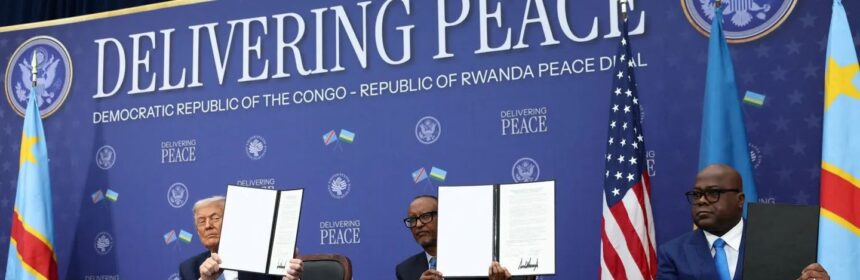
The Washington Agreement, presented with great ceremony as a turning point for peace in eastern Congo, unravelled almost instantly. Within hours of the signatures drying, fighting resumed across the region. The M23/AFC rebels—backed by Rwanda and not party to the agreement—accused government forces of launching new offensives. Kinshasa, in turn, reported fresh Rwandan bombardments of Congolese positions. The fanfare in Washington did nothing to alter facts on the ground. What the event did achieve was political theatre. The deal served primarily to bolster Donald Trump’s image as a peacemaker, echoing—deliberately or not—the misguided confidence of Neville Chamberlain in 1938, when he sought to secure peace by conceding Czechoslovakia to Nazi Germany. Like Chamberlain, Trump appears to believe that conflict can be contained with well-timed handshakes and generous rhetoric. Reality has already contradicted him. Yet buried within the diplomatic spectacle lies one idea with real potential: the Regional Economic Integration Framework […]

Read more