From the President to his Family: The Drainage Ditch

By Alfredo Muvuma Years ago, a high-ranking MPLA politburo member praised the business acumen of President José Eduardo’s children. More recently, the state-owned and only daily newspaper Jornal de Angola awarded Isabel dos Santos the title of entrepreneur of the year for 2012. In both cases, the objective was to sell the notion that there is a genuine business talent, within the Dos Santos’s family, to accumulate vast wealth. Forbes places Isabel dos Santos as the first Africa’s woman billionaire, which it estimates as the value of her legitimate shares in UNITEL, BIC Bank and in Portugal. Meanwhile, the State Budget Bill for 2013, passed days ago by the National Assembly, uncovers the farce: there is no mystery behind the enrichment of the Dos Santos clan and its entourage. Article 11 of the bill explains, in part, how the Angolan president and his cronies accumulate fortunes without sweating, much less […]

Read more

A Record Budget for the Presidency, the Military and the Spooks

Angola’s 2013 budget has been hailed by government propaganda as its greatest ever, owing to how much is being spent on social sectors and in the fight against poverty. The State Budget Bill, approved by the National Assembly on January 15, is expected to become law on February 14. Spending this year is up some 50 percent from 2012, taking the overall budget to a record high of AKZ 6.6 trillion (around US $ 69 billion). In fact, 33.5 percent, over one third of the budget, is allocated for the “social sector,” which includes health, education, housing, environment, and social protection.  It is also true that more is being spent on the “social sector” than ever before. But the headline numbers are misleading. Moreover, focusing on the figures fails to notice that, in essence, the State Budget Bill legalizes in fact presidential unaccountability in the management of the public resources. […]

Read more

Top Police Chief Sells Guns in Angola

The Commander-General of the National Police, Commissioner Ambrósio de Lemos Freire dos Santos, may soon become one of the largest private arms dealers in Sub-Saharan Africa. At stake is the importation of 95,000 arms from Brazil, including sub-machine guns, pistols, revolvers and riot control equipment destined for the National Police. The Commissioner’s company, R & AB, has been brokering the deal with the Brazilian manufacturer Taurus, since 2009. In August 2009, as an urgent need arose, Taurus sold 2,600 pistols to the Angolan National Police at a total price of US $825,000. However, R & AB overcharged the National Police for the consignment of the pistols, which included the models PT917 and PT909 (9mm calibre) handguns. Acting as Taurus’s representative for Southern Africa, R & AB presented the buyer, i.e. the Commander of the National Police, Commissioner Ambrósio de Lemos Freire dos Santos, with an invoice in the value of […]

Read more

Chiefs Denounce Human Rights Abuses in Angola’s Diamond Areas

A delegation of four traditional leaders representing the northeastern provinces of Lunda-Norte and Lunda-Sul provinces delivered today a petition to the Attorney-General of the Republic, general João Maria Moreira de Sousa, denouncing systematic violations of human rights in the diamond areas. The petition asks for the re-opening of a preliminary investigation, archived by the Attorney-General’s office last June, on human rights violations exposed by journalist Rafael Marques in his book Blood Diamonds: Corruption and Torture in Angola. The author lodged a criminal complaint against nine generals of the Angolan Armed Forces (FAA) as moral authors of systematic crimes of torture and assassination committed by guards of their private security company Teleservice. The generals, including the minister of State and head of Intelligence, general Manuel Hélder Vieira Dias “Kopelipa”, are also the owners of private company Lumanhe, the partner of the diamond mining joint-venture Sociedade Mineira do Cuango, in which concession […]

Read more

Arresting the Short and Shabby Journalist

In a repressive state with the veneer of democratically elected institutions, such as Angola, the ways in which abuse is rationalized can sound like a parody. Journalist Coque Mukuta, 28, experienced such a parody on January 4, 2013, while interviewing women street vendors about how they had been arbitrarily beaten by the police while selling in the streets of Viana, in the outskirts of Luanda. “I personally saw, while doing my work, six police officers severely lashing women street vendors with electric wires with the plastic insulation removed (fios eléctricos descascados),” said Mukuta. Rather than leaving the area, the journalist, who is the correspondent for the Portuguese service of Voice of America, remained adamant in finishing the recording of his third interview on site. “They [the six police officers] came straight at me, hauled me off into their vehicle, confiscated my equipment, and slapped me several times, and told me […]

Read more

Arresting the Shabby and Shorty Journalist

In a repressive state with the veneer of democratically elected institutions, such as Angola, the ways in which abuse can be rationalized make parodies. Journalist Coque Mukuta, 28, experienced such a parody on January 4, 2013, while interviewing women street vendors on the arbitrary police beatings against them, for selling in the streets of Viana, in the outlays of Luanda. “I personally saw, while doing my work, six police officers severely lashing women street vendors with electric wires,” said Mukuta. Rather than leaving the area, the journalist, who is the correspondent for the Portuguese service of Voice of America, remained adamant in finishing the recording of his third interview on site. “They [the six police officers] came straight at me, hauled me off into their vehicle, confiscated my equipment, and slapped me several times, and told me I would be thrown in jail,” he said. At the municipal command of […]

Read more

Trafigura and the Angolan Presidential Mafia

In two years of operations in Angola, Pumangol has become a leading player in the marketing of Angolan oil, as well as in the distribution of oil products in the country. This company is a joint venture between multinational Puma Energy, a subsidiary of Swiss based company Trafigura, and its Angolan counterpart Cochan. In August 2010, President José Eduardo dos Santos authorized a total of five investment contracts worth US$ 931 million, by multinational Puma Energy and its Angolan partner Cochan. In  a country ranked among the 15 worst in the world to do business, the rapid success of Trafigura and its subsidiary Pumangol  is, by its own right, a case study and one for an in-depth investigation into its dealings with the presidential inner circle. The Geneva-based company benefits of a swap contract with Sonangol. Trafigura receives Angolan crude oil (in unknown quantities) in exchange for delivering all petroleum […]

Read more

Water for Chevron and a Lesson for the Government

A U.S oil multinational, Chevron, recently kick-started a new venture in Luanda’s most affluent residential area, Talatona:  a water well for the consumption of its employees. The first well for the rich, privileged and expats, in a luxury gated community, is about to pump water to the 100 houses of Condomínio Monte Belo (Beautiful Heights), where most of Chevron’s expat employees live.  Since the August 31 elections, the Angolan capital, Luanda, a sprawling urban chaos with more than five million people, has been plagued by severe water and electricity shortages. Monte Belo is one of the extravagantly expensive gated communities that have mushroomed south of Luanda and it is worth over US $250 million. Chevron commissioned the real estate project to the Brazilian construction multinational Odebrecht, in a joint-venture with a local private company Sakus Empreendimentos e Participações, set up by Sonangol oil executives. Sakus is currently fronted by Mirco […]

Read more

Angola’s Sovereign Wealth Fund – the US $5 billion logo

The Angolan Sovereign Wealth Fund (FSDEA) was launched in October to great fanfare, receiving global media coverage from the likes of the New York Times, CNN and Euromoney. Local and international journalists packed into the shiny new offices by Sagrada Família upmarket area in Luanda to admire the glass and steel spiral staircase, lacquered furniture and raw silk wallpaper. They were given stylish press packs featuring black and white photographs of smiling Angolan children and told how the FSDEA would change Angola for the better and preserve the country’s great oil wealth for the use of future generations. After a lavish lunch buffet complete with drinks served by a suited barman, there was a film shown by a South African production team who had collated clips of “ordinary” Angolans saying how much they loved their country, and a mumbled speech and Powerpoint presentation from Board Chairman Armando Manuel. In the […]

Read more

Alternating Demonstrations: Political Protest and the Government’s Response in Angola

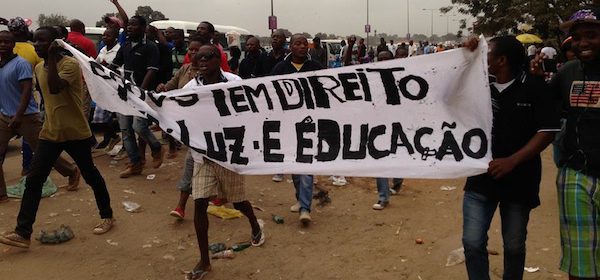
In March 2011, at the height of the North African street protests, an anonymous letter went viral. It called for a mass demonstration in Luanda’s Independence Square, in the capital of Angola, on March 7, 2011. At this symbolic demonstration, the police arrested all seventeen individuals who attended, including three journalists and their driver who were there to cover the event. The ruling Popular Movement for the Liberation of Angola (MPLA) politburo accused Western intelligence services, as well as pressured groups in Portugal, Italy, France, Belgium, Great Britain, and Germany, of disseminating the online letter that demanded an end to President Jose Eduardo dos Santos’s thirty-two year rule. In an anticipated counter-offensive, the MPLA held pro-dos Santos demonstrations in several parts of the country on March 5, 2011, at a staggering cost of over $20 million from the party coffers. State media propaganda claimed that, in Luanda alone, the march […]

Read more
1 … 41 42 43 44 45 … 51