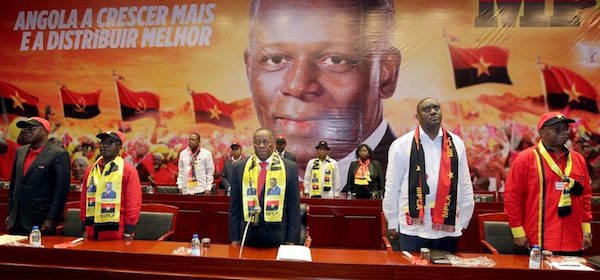
Witchcraft, Police, the MPLA and the murder of a traditional headman.

On May 14, the Provincial Court of Moxico, in Eastern Angola, delivered a landmark verdict against vigilante justice, based on accusations of witchcraft, which is prevalent in that region. Judge Pereira da Silva sentenced both the head of the ruling party, the People’s Movement for the Liberation of Angola (MPLA) for the municipality of Cangamba, Alberto Tchinongue Catolo, and a local traditional authority (Soba) Cangamba, António Kanguia Candimbo, to six years in prison, for ordering the lynching of Soba Augusto Chimbidi. The judge also convicted the municipal commander of the National Police in Cangamba, Manuel N’doje Ijita Cawina to two months in prison for his part in the witchcraft séance plot, which served to justify the mob assassination of Augusto Chimbidi. In his ruling, the judge concluded that the police commander did not take part in ordering the killing, but that he had prevented his police officers from stopping the […]

Read more
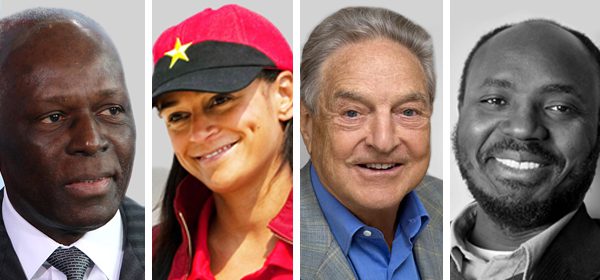
Isabel dos Santos’ Campaign, her Father, George Soros and Me

Isabel dos Santos Portuguese communication consultants, led by Luís Paixão Martins, have for several months been trying to wage a campaign against the author of this article. They have presented no evidence to disprove what I have revealed about the president’s daughter business dealings, particularly acts of corruption by her father. Attempted defamation   Instead, so desperate are they to find a way of attacking me, the author of Maka Angola,  that they have tried to find impropriety in his former links to the NY-based Open Society Institute (OSI), funded by the billionaire philanthropist George Soros. The same ruse has already been attempted without success by the Angolan regime’s own propaganda machine. Nevertheless, the deviousness with which the Portuguese public relations consultant took up this theme is in itself revealing, though more for the crass propaganda campaign than by its content. At the same time, the scheme offers an opportunity […]

Read more

Why Islam is Illegal in Angola

The ban on religious services for Muslims and members of dozens of smaller religious groups in Angola caused an international uproar at the end of November. The international media came to see Angola as the first country in the world to ban Islam. A total of 194 religious denominations, including the Islamic Community of Angola, plus various sects and religious associations that had applied to be granted legal standing, had their requests deferred by the Ministry of Justice and Human Rights. A statement issues by the ministry on 28 October said that for these denominations to continue religious activities would constitute the crime of disobedience on the part of all participants. Since the Law on the Practice and Freedom of Conscience, of Faith and Religion came into force in 2004, the Angolan government has not granted recognition to any church or religious sect. The Angolan state requires that in order […]

Read more

Religion and the State in Angola

The fact that Angola does not recognise Islam as a faith that is practised in the country might give the impression that the Angolan state is particularly Islamophobic. The Angolan media has not hesitated to promote stereotypes that associate Islam with illegal immigration, terrorism and practices that “threaten” the national culture. Often these views are expressed by leading opinion makers in politics, the churches and other institutions. In fact, ever since Angolan independence, the relationship between state power and religion has been marked by political intolerance, ambivalence and co-optation, sometimes in turn and sometimes simultaneously. Right after independence, the official doctrine of atheist Marxist-Leninism served to justify the persecution of religious faiths. In his study of the political stances taken by Angolan Protestants after independence, Benedict Schubert describes the MPLA’s strategy to control churches in the single-party era: “In its totalitarian project, the Angolan government had to find a way […]

Read more

Measures In Favor and Against Mosques in Angola

As an illustration of Maka Angola’s investigation into the treatment of Islam in Angola, here is a chronological list of measures taken by the government regarding Islamic practice in the provinces of Luanda, Lunda Norte, Zaire, Bié and Malanje. The last of these mechanisms were decreed on January 29, 2014 by the Luanda Provincial Court. With reference to Case no. 005713-C, the court ordered the temporary closure of the Nurr Al Islamia Mosque in the Mártires de Kifangondo area of Luanda, because of a dispute between two Imams: Diakité A’dama, a Malian, and Alhaji Fode, a Gambian. Created in 1995, the mosque is the second largest in Angola, large enough to accommodate over 1,500 worshippers. In his ruling, the judge emphasised that the Islamic Community of Angola (CISA) had a request for recognition under consideration by the Religious Affairs Department of the Ministry of Justice. This statement is incorrect. CISA […]

Read more

The MPLA: Speeding Angola up or holding it back?

The MPLA Political Bureau has welcomed the government’s program to speed up the diversification of the national economy, beyond its current domination by the petroleum industry. The Politburo’s statement on 31 March made a special recommendation: that the government should train the personnel necessary to put the plan into practice. However, there is a contradiction here that needs to be analyzed. Let’s start with the idea of “speeding up”. As long ago as 12 February 2009, President José Eduardo dos Santos said “it is necessary to speed up economic diversification by making and promoting investments in other areas of production”. Four years later, the idea of speeding up economic diversification was incorporated into the National Development Plan for 2013-2017, of which implementation began last year. If it is indeed a process of acceleration, it has been a very slow one. As its priorities for economic diversification, the plan aims to […]

Read more

President Dos Santos Clings on to the Old Guard

President José Eduardo dos Santos recently appointed General Kundi Paihama as governor of Huambo province, the second most geostrategically important province in Angola. Paihama, 70, is an important figure in the regime’s old guard. Neither his age nor his history of incompetence and of involvement in shady business dealings stood in the way of his appointment. Paihama was thought to be approaching retirement. In an interview with Radio LAC in August he declared “my dream is to live in the fields, in the countryside, and dedicate myself to farming. This is what I will doubtless do one day when I retire from government.” Will he be tilling his fields when he is 80 or 85 years old? There is an ever more urgent need for the government to respond to the expectations of a young population that is making increasing demands in the areas of education, employment and housing. Paihama, […]

Read more

Radio Ecclesia: Ownership Between Bishops and Rulers

The Angolan Catholic-run Radio Ecclesia has been receiving financial support from the Ministry of Information, even though the government has not yet granted legal status to the radio station. The station was given back to the Catholic Church in 1997 after being banned 20 years earlier. Just last year, Radio Ecclesia simultaneously fired several journalists and cancelled programs without reviewing their ratings. The current management is facing increasing numbers of accusations of censorship. State sponsorship Maka Angola has had access to two documents corroborating a withdrawal order by the Ministry of Finance, to the value of five million kwanzas (US$50,000), for deposit in an account owned by the radio station, in the Banco de Fomento de Angola. The deposit is described as “funding for Radio Ecclesia from the Ministry of Information”. The managing director of Radio Ecclesia, father Quintino Kandanji, informed Maka Angola that he has only received sporadic support […]

Read more
1 … 35 36 37 38 39 … 51