
Angola’s Garbage Tax, Imported Folly
A Disguised Tax
There is also an institutional dimension that makes the measure still more problematic. Angola’s Constitution provides for local authorities as territorial bodies organised at municipal level and endowed with representative organs of their own. The municipal assembly is to be elected by universal, free, direct, secret and periodic suffrage, while the head of the most-voted list becomes the president of the local executive.
Yet Angola still has no functioning elected local authorities and has never held municipal elections. The result is a clear democratic distortion: a levy is being raised for municipal purposes, but municipalities remain run by structures dependent on the central executive rather than by locally elected bodies accountable to residents. Instead of strengthening the local autonomy envisaged by the Constitution, the garbage levy would feed municipal administrations that do not derive their authority from the direct will of the citizens being asked to pay it. Recent reporting continues to note that Angola’s first municipal elections have no fixed date and that the key law on the institutionalisation of local authorities remains pending.
Presidential Decree No. 102/26 therefore raises not only the question of whether this is a fee or a disguised tax. It also raises a question of institutional legitimacy. The state is seeking to collect revenue in the name of municipalities that still lack democratically elected local government. This is fiscal municipalisation without political municipalisation — a contradiction that deepens the constitutional unease and further weakens citizens’ trust in the state.
Imported Folly
Once again, Angola is witnessing a familiar failure in the language and practice of economic governance: to satisfy the expectations of the International Monetary Fund and other international financial institutions, rules are being produced in disregard of the Constitution and detached from the country’s social and institutional reality.
This trend is legally problematic. It also adds new layers of pressure on a population already impoverished by a prolonged economic crisis and worn down by the lack of opportunity.
Common sense appears to have deserted the country’s leadership, which continues to insist on normative solutions designed for immediate convenience, yet structurally fragile and politically counterproductive.
It is in this context that Presidential Decree No. 102/26 emerges. The legal framework it establishes for the so-called Solid Waste Collection and Cleaning Fee raises serious questions about its fiscal nature and constitutional compliance.
The first problem lies in the broad scope of the tax base (who pays) set out in Article 5, which stipulates that all natural and legal persons, whether public or private, who produce solid waste, are obliged to pay the fee.
However, in the case of a fee, payment must constitute consideration for a service actually provided to the taxpayer.
By imposing the fee even on those who do not benefit from a collection service at their place of residence or work, the legislation departs from the reciprocal nature inherent in fees.
If the State charges a fee without providing a specific service, the charge takes on the nature of a tax, intended to finance general expenditure rather than a specific service.
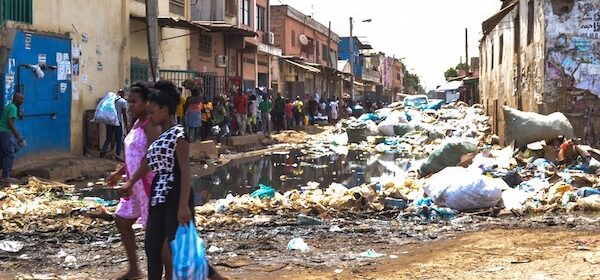
According to available calculations, the Angolan population lacks access to regular waste collection. Only about 25 per cent of urban waste is adequately treated, with formal collection concentrated mainly in major city centres. This leaves vast peripheral areas and musseques with irregular or non-existent services. Though there are positive examples, these are exceptions in a national landscape marked by deep regional asymmetries — a reality the government itself acknowledges, now mapping dumpsites and preparing a national strategic plan to boost waste coverage and management.
Specifically, the Cantinton market in Luanda, where most of the population buys their vegetables, is built on top of rubbish that is not collected, constituting a veritable breeding ground for disease and a danger to public health.
The musseques, where perhaps eight million Luanda residents live, have no proper waste collection systems.
Most Angolans do not benefit from garbage collection.
Increasingly, it is the poor, the dispossessed and the most vulnerable who are being turned into contributors to state expenditure — expenditure that remains steeped in opacity and controversial practices.
Angola is drifting towards an untenable system of taxation in which the poor finance the luxury of the rich. It is not difficult to see how catastrophic this could become for the country’s political stability.
The second critical issue is the calculation basis, defined in Article 9 as 10 per cent of the monthly electricity bill. This breaks the correlation principle: the fee amount should match the service cost or user benefit.
By linking the amount payable to electricity consumption, the decree creates the fiction that those who consume more electricity necessarily produce more waste or benefit more from public cleaning services.
This is a criterion typical of a consumption tax, not of a service fee. It violates the constitutional principles of legality and typicity in taxation.
The legislation exacerbates the conceptual confusion by stipulating, in Article 12, that certain taxpayers — like market vendors — are taxed based on ‘actual or potential use’ of services.
Democratic denial
There is also an institutional dimension that makes the measure still more troubling. Since the 2010 Constitution, Angola has formally provided for elected local authorities organised at municipal level, with representative organs of their own. The Constitution itself states that the municipal assembly should be composed of local representatives elected by universal, free, direct, secret and periodic suffrage.
Sixteen years later, Angola has still not held municipal elections. Since local authorities were constitutionally enshrined in 2010, the government has never allowed the first local elections to take place, leaving municipalities under administrations dependent on the central executive. As of January 2026, the law needed to trigger local elections remained stalled, with analysts pointing to a lack of political will.
In that context, the garbage levy exposes its more authoritarian character. The Executive is seeking to raise revenue in the name of municipalities while denying citizens the elected municipal bodies that should manage those resources and be accountable to local communities. This is fiscal municipalisation without political municipalisation.
The measure is therefore problematic on two levels. As a matter of tax law, it looks like a fee disguising a tax, since citizens may be charged without receiving an effective service. As a matter of constitutional governance, it turns residents into taxpayers for local administrations they did not elect and cannot hold accountable through the ballot box. Citizens are asked to pay as municipal taxpayers while being denied the right to choose their municipal government.
This is not merely a technical measure to finance urban sanitation. It is an authoritarian decision that reinforces centralisation, postpones local autonomy and shifts onto citizens the cost of institutional inertia imposed from above. In doing so, the levy widens the gap between Angola’s constitutional text and its governing practice, further weakening public trust in the state.
In short, it appears to constitute a tax of an essentially fiscal nature, even though it is presented as a fee.
The disconnect between the chargeable event, the basis of calculation and the provision of the service undermines its constitutionality and reveals a worrying trend of legislative production driven more by external imperatives than by internal legal coherence and the protection of citizens.
The final decision on its constitutionality will, of course, rest with the Constitutional Court, but the indications of unconstitutionality are significant and merit serious reflection at a time when the country needs to strengthen institutional trust rather than further undermine it.
Responsible governance requires common sense, as well as deep knowledge of the concrete reality of the territory and of the social and economic dynamics that shape citizens’ daily lives.
Those countries relied on active industrial policies, the protection of strategic sectors, selective capital controls, robust public investment and, above all, a pragmatic reading of their own internal needs.
Thus, the debate over constitutionality is not merely a legal exercise. It forms part of a much larger discussion about the kind of state Angola intends to consolidate.
A state that builds, based on its own reality, the material and institutional conditions to fully exercise its autonomy in an increasingly competitive and fragmented world.