
Intelligence Officer Arrested in Connection with the Alleged Coup Plot

Captain Zenóbio Lázaro Muhondo Zumba, 34 years old, became the first collateral victim of searches being carried out by the Criminal Investigation Service (SIC) and by Intelligence Services on computers, writings and other documentation seized from the 15 people arrested for allegedly plotting a coup. On June 30 past, the captain arrived at the headquarters of the Military Intelligence and Security Service (SISM), where he is an analyst at the Information and Analysis department attached to the General Staff of the Angolan Armed Forces (FAA). He thought it was just another normal day at work. According to information given by his wife, Suzana Zumba, members of the Military Police showed Captain Zumba a photograph of Lieutenant Osvaldo Caholo, who had been arrested at home on June 24. “Zenóbio said that he knew him, since they had both been classmates in the International Relations’ degree program in UTANGA [Technical University of […]

Read more
Sharks or Crocodiles: How to Get Rid of an Activist in Angola

Since June 20, much has been said and written about the detained Angolan book club activists, accused of attempting to bring about a coup d’état.  State officials, including Attorney-General Joao Maria de Sousa and Interior Minister Angelo Tavares, have emphasised In their statements to the media that they will zealously uphold the law, make arrests or take any and all other appropriate action against those who conspire to overthrow President Jose Eduardo dos Santos’s government. But their treatment of another activist, 28 year-old Mario Faustino, detained since May 27, exposes the shambolic nature of the Angolan Justice system. In an exclusive interview for Maka Angola, from his prison cell in the National Police provincial headquarters in Luanda, Mr Faustino alleges that when he was detained, he was subjected to torture at a military installation, carried out in person by a Brigadier in the Angolan Armed Forces (FAA).  According to the […]

Read more

President José Eduardo dos Santos’ Regime is Afraid of Books

A Maka Angola reader has raised a pertinent question concerning the detention on 21 June of 13 activists who were busy discussing methods of peaceful protest against what they consider to be a dictatorship. Two more activists were detained in the following days, and all fifteen were accused of plotting a coup d’etat. Most of these activists are known for their ill-fated attempts to organize anti-government demonstrations, which have been brutally suppressed. But how is it possible, the reader asks, that people who cannot manage even the most basic protest without being violently clamped down and detained, could have the means to organize a coup d’etat? Tired, perhaps, of being the punching bag for the authorities and of being accused by a part of civil society of being disorganized, the young people decided to form a study group. They armed themselves with books on peaceful forms of protest in order […]

Read more

Putin-Style Presidential Decree Ends NGO Independence in Angola

Civil society in a democratic state is generally defined as the space filled by   non-governmental organisations and institutions that represent citizens’ interest and the public will and which are independent from the state. Hegel, the philosopher of the modern state, considered that civil society, with all its differences, made the nation state more efficient. If Angola is consolidating its democracy under the 2010 Constitution, Presidential Decree 74/15 of 23 March 2015, which regulates non-governmental organisations (NGOs), raises a matter of grave concern. This decree echoes the legal technique used by the Russian autocrat Vladimir Putin, who in 2012 introduced legislation obliging foreign NGOs to register with the Foreign Ministry as “foreign agents”. This effectively turned all NGO staff into hypothetical “spies”. The Angolan presidential decree includes a series of provisions that make it practically impossible for NGOs to work in an independent and impartial manner as the representatives of civil […]

Read more

Angolan Authorities Detain Youth Protesters as “Coup Plotters”

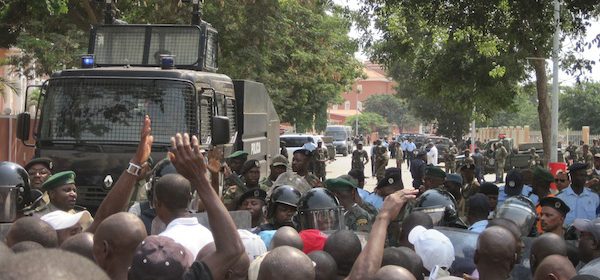
For the Angolan authorities, the very thought of an Angola without President José Eduardo dos Santos at its helm, let alone any protest against his rule, continues to be a matter of crime and punishment. President dos Santos has been in power for 36 years and wants to be celebrated as the architect of peace and guarantor of stability, though opponents say he is ruining the country. On Wednesday the attorney general of the Republic, Army General João Maria de Sousa, confirmed the detention of 15 youths for allegedly preparing acts of collective disobedience to overthrow the government, and unseat president Dos Santos. “These acts constitute crimes against the security of the state, as a crime of rebellion. As such, the competent bodies of the state must take action to avert the worst”, General João Maria de Sousa told the press. Several youths have been undergoing interrogation sessions since Monday […]

Read more

Angola’s Sovereign Fund Pays US $100 Million to a Shell Company

On 22 January 2015, Angola’s Sovereign Wealth Fund (FSDEA) transferred the sum of 9 948 750 000 kwanzas (equivalent at the time to US$100 million) to the company Kijinga S.A. This company is nothing more than a shell company set up as a front for shady transactions by Banco Kwanza Invest (BKI), a bank created by the 36-year-old José Filomeno dos Santos “Zenú”, the current chair of the FSDEA and the son of the President of the Republic. Kijinga S.A. shares an office with BKI at 150 Avenida Comandante Jika, next to the Maternity Hospital in Luanda. This address has only one business door, which opens into a small waiting room where there is a reception area and two chairs for visitors. One of these chairs is usually occupied by a security guard, in addition to the guard on duty outside the door. The windows are darkened glass, which does […]

Read more

Freedom of Expression: a Crime against the State Security in Angola

In the oil-rich enclave of Cabinda, in the northernmost part of Angola, three individuals share a prison cell, since March 14, charged with crimes against the state security and sedition, for a protest against bad governance and human rights abuses, which never took place.  Their arrests and the charges leveled against them,  are what illustrate the sophistication of the authoritarian rule in Angola. Members of the state security arrested Marcos Mavungo, a university lecturer and oil worker for Chevron, as soon as he exited the Catholic Church where he attended morning mass at 7h00. He was, in fact, the lead proponent of the protest.  The local government swiftly prohibited holding the protest the moment it was notified by the organizers several days before. The demonstration was supposed to be held in the afternoon but the ban, and the massive deployment of police officers in the small urban district of Cabinda […]

Read more

Crisis, What Crisis in Angola?

As Angola’s economic crisis deepens, the country’s president has given priority to the construction of a war memorial at an estimated cost of US $72 million, and a further US $73 million going to a phantom category of “non-specific religious affairs and services”.  These projects fall under the Office of Special Works of the Presidency of the Republic. Both expenditures are part of the revised 2015 budget, passed by the National Assembly on March 20, which was slashed by 25 percent (over US $17 billion) – including cuts in the salaries of civil servants. Despite the reduction of the budget due to the fall in oil prices, the president’s  set of priorities are baffling. Oil accounts for approximately 95 percent of Angola’s total exports, and its economy is mono-dependent on this commodity. For instance, the largest state-funded religious project, the construction of the Sanctuary of Muxima for the Catholic Church, […]

Read more

I Believe in the Power of Solidarity

With an award comes a greater responsibility. It is therefore my privilege to accept this journalism award [from Index on Censorship], and dedicate it to my fellow Ethiopian colleagues Eskinder Nega, Reeyot Alemo, and the Zone 9 bloggers. They are in jail, currently serving some of the harshest sentences in Africa, for the crime of exercising their right to freedom of expression. For over a year, the Ethiopian government has denied adequate health care to Reeyot Alemu, who is in desperate need. Ethiopia is the seat of the African Union, and its regime is one of the worst offenders for upholding the freedoms of the press and of expression. When a regime in Africa succeeds in trampling their citizens’ rights with impunity, and enjoys such good international standing and legitimacy as Ethiopia, it becomes a textbook case for other authoritarian regimes. I believe in the power of solidarity. I have […]

Read more

Government Profits from Beer and Blames the Oil Prices

The crisis, which the government blames on falling oil prices, has been used to disguise a much older and deeper crisis  that already existed long before the reasons given by the government lately. The Court of Accounts provides some alarming evidence in its report to parliament on the Government’s Budget Execution Report for 2013 . According to the Court of Accounts report, reviewed by Maka Angola, in 2013 the state was paid dividends to the tune of 95.4 million Kwanzas (US$954,000) on its direct shares in a total of 37 companies. The sum is ridiculously low given the government’s multi-billion dollar investments in the private sector. Apart from the national oil company Sonangol, the state only made a profit on beer sales from its shares in three beer producers. Dos Santos’ government billed Cuca for 67.9 million Kwanzas; a further 23.5 million from N’gola and another 4 million from Eka. […]

Read more
1 … 32 33 34 35 36 … 51